This is a excerpt of a longer essay: Climate Crisis and Human Health in the XXI century.
“I look through a half-opened door into the future, full of interest, intriguing beyond my power to describe, but with a full understanding that it is for each generation to solve its own problems and that no man has the wisdom to guide or control the next generation.”
― William J. Mayo, MD.
The scientific community has been sounding the alarms about the warming of the planet since the late seventies. In recent decades the epidemics we have seen have shown warnings of the others to come. Meantime the scientific community has produced enough evidence to predict the origins of those diseases and predict the consequences of the climate change. But we still look in other direction. Why are we so disconnected from the present realities that anticipate future events? What is our focus and how shall we reconnect with our future?
“The evolution and sustenance of our planet hinges on a symbiotic relationship between Humans, Animals, and the Environment that we share – we are interconnected.”[i] During decades we have created powerful economic systems that encourage overconsumption of resources to the detriment of the people and the planet. Rampant inequality is undermining prosperous western democratic countries and destabilizing their social and political life. Changes in the climate of the planet along with the extreme amount of pollution we produce are eradicating biodiversity, modifying the weather and destroying nature. These undeniable facts are telling us that the model of growth and progress where capitalism resides, on the basis of infinite resources and continuous growth, is no longer sustainable.
Our planet is facing a syndemic situation, where the Health, Climate and future Survival of our planet are in serious jeopardy. The combination of Climate Change and Disease is a Juggernaut: a devastating and overwhelming event of such a powerful force that we will not be able to avert once its wheels are turning.
While we advance into the twenty-first century, humanity has been working to find solutions to these indisputable problems, but the uniqueness and nature of this issues are so enormous and serious that demands action on an unprecedented scale never seen before. Together we have accomplished fabulous scientific breakthroughs and discoveries that have brought prosperity and progress to our civilization. We have also managed to unleash horrors and create technology to inflict destruction upon others. The solutions to our big world problems come from a small planet perspective, because “no one does anything worthwhile on its own. We’re all in this together. Whether you like it or not”[ii]. Yes, society is such a thing since ten thousand years ago when we where hunters and foragers. We depend on each other to survive in this universe.
I do not argue against capitalism as a prosperous economical model, but today we have many reasons to think that capitalism and neoliberal economy are rogue and bolted,unleashing self-destructive forces. The prosperous economic model that one day we considered did not had other alternative and we blindly followed, represents today the main hurdle to overcome our existential crisis. This model is not sustainable and represents a solid obstacle to the solutions we need. Overhauling capitalism and the economic model around is therefore imperative to tackle the climate and health conundrum. We cannot leave health and climate at the mercy and whims of free markets and spurious profit interests anymore.
We have the relentless capacity and strength of our minds to provide technological, medical and political solutions through the scientific method, but “if we approach science without policy, we will accomplish nothing, and if we institute policy without good science behind it, we will squander precious time, money and lives.”[iii] At the end we might not need politics or partisanship, unjust economic theories or crippled bureaucracies. These need to be part of the solution but cannot represent the part of a systemic problem.
There is certainly an issue in communicating science to the public. Marketing of consumer products make more impact in the public than any scientific message. Most individuals know better the roster of the Dallas Cowboys or the new features of the latest iPhone but are ignorant of the dangers of not having clean water in our neighborhoods or vaccinated children attending school. The rhetorics of science need to improve delivering the message of climate change and public health using more marketable means. The hurdles that James Hansen overcame until 1988 trying to deliver his message about climate change to Congress are a testament of this.[iv] The scientific community has been raising concerns about global warming and the risk of epidemic outbreaks for decades and the message fails to hit policymakers and the public with enough emphasis and intensity to shift the focus and our priorities. While we are not focused and the world is out of balance, we get surprised by SARS, then by Hurricane Sandy, by Ebola and now we have been surprised by Covid-19. We didn’t knew, but our scientists did new, they told us, and we did not hear, like we did not heard Copernicus, Galileo, Magellan and many others at their time.
Today we cannot assume that the juggernaut syndemic will stop its destructive path while the sacrifice is ongoing, we need to act before it starts. The nature of our problem is that is profoundly an existential one. We necessarily need not just to think together for ourselves but think, feel and dream for the ones that do not exist today, for the ones that will be here when we will not be here any more. Not for our grand children but for the grand children of our neighbors and the children of someone somewhere remotely away from our country. It will not be the same while we are not here and we do not want to hand them a world that we would not want to inhabit ourselves.
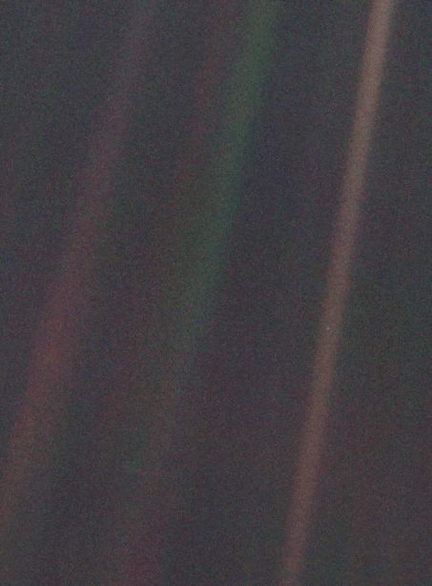
On February 14th 1990, after 13 years of travel and 3.7 billion miles tour, the robotic space probe Voyager 1 left the solar system and entered outer space forever. As it was departing our planetary neighborhood into the fringe of the solar system, it turned across the expanse of space to take a last look at its home planet. Earth appeared as a tiny “pale blue dot” against the vastness of space amongst scattered sunbeams. Astronomer and science communicator Carl Sagan who suggested the idea of the photograph to NASA then wrote:
“Look again at that dot. That’s here. That’s home. That’s us. On it everyone you love, everyone you know, everyone you ever heard of, every human being who ever was, lived out their lives. The aggregate of our joy and suffering, thousands of confident religions, ideologies, and economic doctrines, every hunter and forager, every hero and coward, every creator and destroyer of civilization, every king and peasant, every young couple in love, every mother and father, hopeful child, inventor and explorer, every teacher of morals, every corrupt politician, every “superstar,” every “supreme leader,” every saint and sinner in the history of our species lived there–on a mote of dust suspended in a sunbeam.
Our posturings, our imagined self-importance, the delusion that we have some privileged position in the Universe, are challenged by this point of pale light. Our planet is a lonely speck in the great enveloping cosmic dark. In our obscurity, in all this vastness, there is no hint that help will come from elsewhere to save us from ourselves.
The Earth is the only world known so far to harbor life. There is nowhere else, at least in the near future, to which our species could migrate. Visit, yes. Settle, not yet. Like it or not, for the moment the Earth is where we make our stand.”[v]
[i] Amuasi, John H., et al. “Reconnecting for our future: The Lancet One Health Commission.” The Lancet 395.10235 (2020): 1469-1471.
[ii] Olshaker, Mark, and Osterholm, Michael T.. Deadliest Enemy: Our War Against Killer Germs. United States, Little, Brown, 2017. Page 24.
[iii] Olshaker, Mark, and Osterholm, Michael T.. Deadliest Enemy: Our War Against Killer Germs. United States, Little, Brown, 2017. Page 30.
[iv] Besel, Richard. “Accommodating climate change science: James Hansen and the rhetorical/political emergence of global warming.” (2013): 137.
[v] Druyan, Ann, and Sagan, Carl. Pale Blue Dot: A Vision of the Human Future in Space. United States, Random House Publishing Group, 2011. Page 6-7.
 Our Funnaminal World