The American Green New Deal – A case in its favor.

The earth’s warming is inviting humanity to reframe the way we live as individuals and also revise how we organize socially. Approach to climate warming economy and policy tends to focus on specific ways to decouple energy production from fossil-fuels by using different financial mechanisms like carbon taxation, cap-and-trade, market based measures and strong investment in technological innovation and R&D. Although solving climate warming is sometimes seen as an opportunity for an entire transformation of the world, we rarely speak about what are the systemic issues that perpetuate it and have stalled its change for decades since James Hansen and other American scientists raised the alarms of global warming in the seventies [1].

As the Rooseveltian New Deal that in the 1930’ies helped to overcome the Great Depression and that financed the War efforts, the Green New Deal makes a case for the social aspects of climate justice and aims to tackle the threat that climate change poses to the American security, poverty and social inequality, through an ambitious proposal of robust government investment programs. The GND was first called by Thomas L. Friedman in a New York times column published in 2007 titled: “A Warning from the Garden” [2]. Thereafter brewed for a decade in the wake of the 2008 financial crisis until it was introduced in February 2019 by congresswoman Alexandria Ocasio-Cortez and Senator Ed Markey.

The aims of the GND is a transformational overhaul of financial capitalism, wealth distribution and corporate tax, addressing climate justice, racial justice, gender inequality and the increasing gap in wealth between rich and middle class in America. All of these issues are in many ways connected to climate warming and emissions mitigation. Therefore, to tackle climate change the GND plans to encompass multifaceted solutions to these questions in coordination with the technical and financial ones more specific to the decarbonization of our energy systems and greenhouse gas emissions.

Historically there is no doubt that FDR’s New Deal brought prosperity and shaped the Unites States middle class, ending austerity and unemployment for decades. Today, despite living in a polarized political era, most Democrats and 64% of Republicans backed the plan; until they knew it was promoted by AOC [3]. But the GND resolution not just faces strong opposition from the predominant Neoliberal ideology, it also lacks precision on how it will be engineered, making it look just as a mere statement of intentions. Reaching better understanding demands researching academic papers, books and other sources (like Bernie Sanders GND) that explain the plan.   

In what relates to economy, the way the GND is framed aims at the political gridlock between Neoclassical and Keynesian conceptualization monetary policy. These opposed views have inhabited the political conversation for decades, the prevalent view being the Neoliberal, which remains unchallenged and mainstream for about forty years since the first Reagan administration. This one believes in minimal government intervention leaving control over the monetary system to private authority (the markets) and hence expecting that the efficiencies of the free markets will deploy the solutions needed to abate climate disasters. In this train of thought historian of science at Harvard University, professor Naomi Oreskes, recently published an article in Scientific American arguing in opposition to this idea saying: “Will nations ever come together to keep climate out of the severe danger zone? […] the nation’s ambivalence about climate change long predates the last presidential election. A major reason is some American conservatives hostility to government intervention. If the U.S. and the world are to succeed in limiting disruptive climate change, the U.S. will have to give up the idea that free markets alone can adequately address climate change and accept the reality that markets need help from governments” [4]. I understand Oreskes statement as a call for market regulation.

 The GND poses challenges to the widely accepted ideas of financial capitalism and globalized economy demanding a major system change. In the words of Ann Pettifor, “to tackle climate change we need simultaneously to tackle the root cause of growing toxic emissions: a self-regulating, globalized financial system that pours exponential quantities of unregulated credit into the hands of speculators and consumers. This credit is used in turn to inflate the prices of existing assets [..] further it is used to accelerate the extraction and consumption of earths finite assets.” [5]. According to Pettifor overhauling this market mechanisms are at the center of the GND. This idea is in line with others progressive scholars and economists that argue in favor of pursuing limits to growth as opposed to the widely neoliberal idea of endless resources and unlimited economic growth (i.e. sustainable against unsustainable economy).

To the legitimate concern if the GND will be inflationary, Galvin and Healy run the numbers and argue that it would require an estimated increase of 40% in taxes, “not breaking any vital economic rules and would not lead to inflation if managed sensibly”[6]. The question is left to whether the US society would accept this tax rates. According to the Tax Policy Center – Urban Institute & Brookings Institution, “US taxes are low relative to those in other high-income countries. In 2018, taxes at all levels of US government represented 24 percent of gross domestic product (GDP), compared with an average of 34 percent for the other 35 member countries of the Organization for Economic Co-operation and Development (OECD)” [7]. In the Eurozone the Tax-to-GDP ratio in 2018 was 40.3 percent [8]. This discussion is very present at the moment in the US political arena and deserves a strong debate because it will influence our future economic decisions and climate change actions.

Austerity was the buzz word after the 2008 financial crisis and it has been the recipe for all economic crises in the last forty years. But it has not entirely worked as expected for the great majority of the working class, resulting in a transfer of wealth from the bottom to the 1 percent top. Needless to say the loss of wealth of most middle class. The idea of ‘there is no money’ should be discarded as an economic option because money as a technology to trade, consume and invest should enable us to do what we need to do to solve the problems we have as a civilization. There lies the question between Neoclassical and Keynesian models of understanding monetary policy (exogenous or endogenous origins of money). Like Galvin and Healy point out in their paper, I also support the argument in favor of challenging the Neoclassical-Neoliberal model. I argue that the way Neoliberal economics have operated in the last four decades is impacting the planet’s climate and the social cohesion of most Western developed countries in a negative manner. Democracy and Capitalism have provided the framework for economic prosperity and innovation, however unrestrained financial capitalism and endless growth is coming at a cost that is socially and environmentally unsustainable. Having reached this watershed moment should invite us to reflect on to where  this economic model is taking us.

Consensus is building towards the acceptance that Climate solutions come through collective pursuit of the greater common good. That everyone needs to pay its fair share, participate in the solutions and get to work to solve the greatest threat humanity has ever faced. Whereas these efforts should come from higher taxes, market efficiencies, massive government infrastructure projects, climate clubs or trans-national agreements is something that we need to have a discussion about. But the climate window narrows leaving us with little time to act. I believe we need to work in all these options together and it will lead us to the best possible outcome.   

References

___________________

[1] Rich, Nathaniel. Losing Earth: A Recent History. New York: Picador, 2019.

[2] Friedman, Thomas L. “A warning from the Garden”: https://www.nytimes.com/2007/01/19/opinion/19friedman.html

[3] Gustafson, Abel, et al. “The Green New Deal has strong bipartisan support.” Yale Center for Climate Change Communication and the George Mason University Center for Climate Change Communication (2018).

[4] Oreskes, Naomi. “How to break the climate deadlock.” Scientific American 313.6 (2015): 74-79.

[5] Pettifor, Ann. The case for the Green New Deal. London: Verso, 2019. 8-9.

[6] Galvin, Ray, and Noel Healy. “The Green New Deal in the United States: What it is and how to pay for it.” Energy Research & Social Science 67 (2020): 101529.

[7] Tax Policy Center (Urban Institute & Brookings Institute) https://www.taxpolicycenter.org/briefing-book/how-do-us-taxes-compare-internationally#:~:text=Budget%20and%20Economy-,How%20do%20US%20taxes%20compare%20internationally%3F,average%20for%20other%20OECD%20countries

[8] Eurostat/News Release 166/2019. 30 October 2019. https://ec.europa.eu/eurostat/documents/2995521/10190755/2-30102019-AP-EN.pdf/68739572-f06a-51e4-3a5b-86e660a23376
Sailing at the whims of mighty currents.

When we study navigation and seamanship in the Navy School, we go back to the traditions of the old navigators; those that more than two millennia ago followed their instincts and understanding of the signs drawn from the natural world: winds, clouds, oceanic currents, stars and tides. Nature somehow taught us it’s jargon and we learnt how to sail across the seas following her signs. Scientific breakthrough and technological innovation did the rest to accomplish all the magnificent explorations and discoveries we have accomplished, but despite how much we have progressed, even today, we still follow the cues of nature when we sail across the ocean.

         At the beginning we were constrained and feeling comfortable in the Mediterranean. When European navigators entered the Atlantic Ocean in the fifteenth and sixteenth centuries  we quickly became aware of how lost we were. The Jacob’s staff and Quadrant helped us locate ourselves by latitude, and the lateen rigging provided the benefit to sail windward in small crafts like caravels. Even after Columbus made it across into the Caribbean in 1492, we used to get lost in the Atlantic and come back to Europe by the benevolence of mighty currents and forgiving wind systems that circle the Atlantic in a clockwise direction. Each time we came back we built more knowledge and understanding of the Atlantic’s Ocean-Atmosphere interactions systems known today as the North Atlantic Gyre

         Amongst the currents the North Atlantic Gyre is composed of the most influential one is the Gulf Stream. The Gulf Stream originates in the warm waters of the Gulf of Mexico where it swiftly exits through the Straits of Florida following the eastern coastline of North America into the Grand Banks of Newfoundland. There it bends to the East extending into the North Atlantic Drift where it splits in two branches, a northern and colder direction into the North Sea and a warmer and southeasterly direction into the Canary Islands. In the Atlantic Basin the Gulf Stream and the North Atlantic Drift regulate the climate from Florida to Newfoundland and the coasts of North and Western Europe. During millennia, these currents have shaped the climate and therefore life and history in the European and North American continents.  

         But not all happens on the surface. These currents are the limbs of a much broader system of ocean-spanning currents known as the Atlantic Meridional Overturning Circulation (AMOC): a system of surface and deep currents influenced by wind stress and thermohaline circulation that distributes heat across the planet. This complex network of currents powered by heat, salinity and wind, transport vast amounts of energy and nutrients from the tropics into the North Atlantic like a conveyor belt. The warm and saline water of the Gulf Stream loses temperature and cools down in the North Atlantic where it sinks into the deeper layers of the abyssal ocean traveling South on a thousand year voyage across the oceans.       

         The influence of AMOC is considered unique in the world’s oceans and is believed to be responsible for the warmer milder climate of the northern hemisphere, specially northwestern Europe. AMOC also represents a very important carbon sink in the northern hemisphere sequestering around 0.7 billion tons of Carbon yearly (0.7PgC/year).

         Before the grandiose power of the Atlantic’s Ocean-Atmosphere system, we face an existential climate crisis where we look like ancient mariners living at the whims and mercy of currents and winds. The stability of the AMOC seems to be extremely relevant to our livelihood and climatic stability. Changes in the AMOC and its enormous tentacles of water will impact atmospheric circulation and consequently will influence rainfall, temperatures, winds, sea levels and hurricane patterns from the Sahel to Greenland and Mesopotamia to Minnesota. This potential change is one of the “tipping points” that scientists have their eyes on.

         Like a game of “jenga”, tipping points represent changes in climate that can push the earth’s systems that sustain life into abrupt and irreversible conditions. A breakdown of the Atlantic Circulation by the slowing down of the AMOC would cause a disruption of the oceanic ecosystem. 

         The AMOC is highly dependent on salinity and temperature gradients in the ocean and scientists suspect that the AMOC is slowing down in response to anthropogenic global warming. Paradoxically, everywhere in the planet temperatures are rising due to the greenhouse gases emissions into the atmosphere, but a region in the subpolar North Atlantic close to the Southern tip of Greenland is cooling down because of the melting of its ice sheets. This cold blob is called by scientists the North Atlantic warming hole

Scientists argue that sudden introduction of freshwater into the North Atlantic could be disturbing the sinking of denser saltier water coming from the tropics in the Gulf Stream, overturning the critical phase of the AMOC that drives the circulation when warm water cools and sinks reversing its direction deep into the Atlantic Ocean. This regional reduction in the surface ocean density, driven by changes in accumulated freshwater input from the Greenland Ice Sheets has become critical to understand what is happening in the AMOC and its relation with a weakening Gulf Stream current. This freshwater event was described in an article published in 1988 by Dickson, R. et al called “The Great Salinity Anomaly” as “one of the most persistent and extreme variations in global ocean climate yet observed in this century”.

  We have no certainty of the impact a shutdown of the AMOC will have on the climate. Scientists have dung in the past thousands of years and more recent behavior of AMOC and the news are troubling. Slowing down or even shutting down of the currents in the Atlantic could accelerate sea level rise, strengthen hurricanes, exacerbate global heating, bring extreme warming into Europe to the scale of the Sahara desert, change the planet’s radiation budget, disturb the general circulation of gases in the atmosphere and modify the ability of the ocean to absorb one third of human carbon dioxide emissions.

Like the Flying Dutchman, we live today wandering around a sea of uncertainty. As an everyday person, I do not know how I can contribute to avoid this. Despite all the progress we have accomplished we are again sailing at the whims of  mighty currents and forgiving wind systems that circle the Atlantic.

Pale Blue Dot: Big World, Small Planet.

This is a excerpt of a longer essay: Climate Crisis and Human Health in the XXI century.

“I look through a half-opened door into the future, full of interest, intriguing beyond my power to describe, but with a full understanding that it is for each generation to solve its own problems and that no man has the wisdom to guide or control the next generation.”

― William J. Mayo, MD.

            The scientific community has been sounding the alarms about the warming of the planet since the late seventies. In recent decades the epidemics we have seen have shown warnings of the others to come. Meantime the scientific community has produced enough evidence to predict the origins of those diseases and predict the consequences of the climate change. But we still look in other direction. Why are we so disconnected from the present realities that anticipate future events? What is our focus and how shall we reconnect with our future?

            “The evolution and sustenance of our planet hinges on a symbiotic relationship between Humans, Animals, and the Environment that we share – we are interconnected.”[i] During decades we have created powerful economic systems that encourage overconsumption of resources to the detriment of the people and the planet. Rampant inequality is undermining prosperous western democratic countries and destabilizing their social and political life. Changes in the climate of the planet along with the extreme amount of pollution we produce are eradicating biodiversity, modifying the weather and destroying nature. These undeniable facts are telling us that the model of growth and progress where capitalism resides, on the basis of infinite resources and continuous growth, is no longer sustainable.

            Our planet is facing a syndemic situation, where the Health, Climate and future Survival of our planet are in serious jeopardy. The combination of Climate Change and Disease is a Juggernaut: a devastating and overwhelming event of such a powerful force that we will not be able to avert once its wheels are turning.

            While we advance into the twenty-first century, humanity has been working to find solutions to these indisputable problems, but the uniqueness and nature of this issues are so enormous and serious that demands action on an unprecedented scale never seen before. Together we have accomplished fabulous scientific breakthroughs and discoveries that have brought prosperity and progress to our civilization. We have also managed to unleash horrors and create technology to inflict destruction upon others. The solutions to our big world problems come from a small planet perspective, because “no one does anything worthwhile on its own. We’re all in this together. Whether you like it or not”[ii]. Yes, society is such a thing since ten thousand years ago when we where hunters and foragers. We depend on each other to survive in this universe.

            I do not argue against capitalism as a prosperous economical model, but today we have many reasons to think that capitalism and neoliberal economy are rogue and bolted,unleashing self-destructive forces. The prosperous economic model that one day we considered did not had other alternative and we blindly followed, represents today the main hurdle to overcome our existential crisis. This model is not sustainable and represents a solid obstacle to the solutions we need. Overhauling capitalism and the economic model around is therefore imperative to tackle the climate and health conundrum. We cannot leave health and climate at the mercy and whims of free markets and spurious profit interests anymore.

            We have the relentless capacity and strength of our minds to provide technological, medical and political solutions through the scientific method, but “if we approach science without policy, we will accomplish nothing, and if we institute policy without good science behind it, we will squander precious time, money and lives.”[iii] At the end we might not need politics or partisanship, unjust economic theories or crippled bureaucracies. These need to be part of the solution but cannot represent the part of a systemic problem.

            There is certainly an issue in communicating science to the public. Marketing of consumer products make more impact in the public than any scientific message. Most individuals know better the roster of the Dallas Cowboys or the new features of the latest iPhone but are ignorant of the dangers of not having clean water in our neighborhoods or vaccinated children attending school. The rhetorics of science need to improve delivering the message of climate change and public health using more marketable means. The hurdles that James Hansen overcame until 1988 trying to deliver his message about climate change to Congress are a testament of this.[iv] The scientific community has been raising concerns about global warming and the risk of epidemic outbreaks for decades and the message fails to hit policymakers and the public with enough emphasis and intensity to shift the focus and our priorities. While we are not focused and the world is out of balance, we get surprised by SARS, then by Hurricane Sandy, by Ebola and now we have been surprised by Covid-19. We didn’t knew, but our scientists did new, they told us, and we did not hear, like we did not heard Copernicus, Galileo, Magellan and many others at their time.

            Today we cannot assume that the juggernaut syndemic will stop its destructive path while the sacrifice is ongoing, we need to act before it starts. The nature of our problem is that is profoundly an existential one. We necessarily need not just to think together for ourselves but think, feel and dream for the ones that do not exist today, for the ones that will be here when we will not be here any more. Not for our grand children but for the grand children of our neighbors and the children of someone somewhere remotely away from our country. It will not be the same while we are not here and we do not want to hand them a world that we would not want to inhabit ourselves.

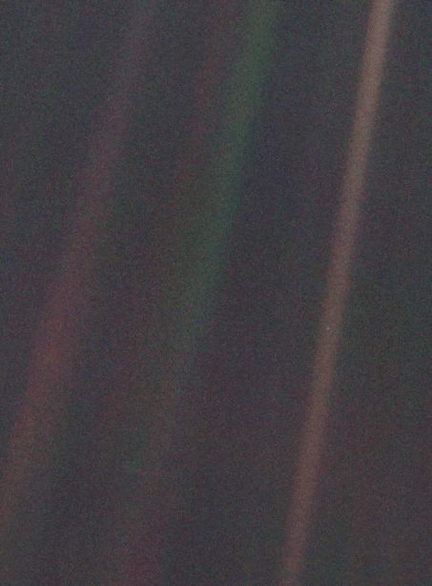
            On February 14th 1990, after 13 years of travel and 3.7 billion miles tour, the robotic space probe Voyager 1 left the solar system and entered outer space forever. As it was departing our planetary neighborhood into the fringe of the solar system, it turned across the expanse of space to take a last look at its home planet. Earth appeared as a tiny “pale blue dot” against the vastness of space amongst scattered sunbeams. Astronomer and science communicator Carl Sagan who suggested the idea of the photograph to NASA then wrote:

            “Look again at that dot. That’s here. That’s home. That’s us. On it everyone you love, everyone you know, everyone you ever heard of, every human being who ever was, lived out their lives. The aggregate of our joy and suffering, thousands of confident religions, ideologies, and economic doctrines, every hunter and forager, every hero and coward, every creator and destroyer of civilization, every king and peasant, every young couple in love, every mother and father, hopeful child, inventor and explorer, every teacher of morals, every corrupt politician, every “superstar,” every “supreme leader,” every saint and sinner in the history of our species lived there–on a mote of dust suspended in a sunbeam.

            Our posturings, our imagined self-importance, the delusion that we have some privileged position in the Universe, are challenged by this point of pale light. Our planet is a lonely speck in the great enveloping cosmic dark. In our obscurity, in all this vastness, there is no hint that help will come from elsewhere to save us from ourselves.

            The Earth is the only world known so far to harbor life. There is nowhere else, at least in the near future, to which our species could migrate. Visit, yes. Settle, not yet. Like it or not, for the moment the Earth is where we make our stand.”[v]


[i] Amuasi, John H., et al. “Reconnecting for our future: The Lancet One Health Commission.” The Lancet 395.10235 (2020): 1469-1471.

[ii] Olshaker, Mark, and Osterholm, Michael T.. Deadliest Enemy: Our War Against Killer Germs. United States, Little, Brown, 2017. Page 24.

[iii] Olshaker, Mark, and Osterholm, Michael T.. Deadliest Enemy: Our War Against Killer Germs. United States, Little, Brown, 2017. Page 30.

[iv] Besel, Richard. “Accommodating climate change science: James Hansen and the rhetorical/political emergence of global warming.” (2013): 137.

[v] Druyan, Ann, and Sagan, Carl. Pale Blue Dot: A Vision of the Human Future in Space. United States, Random House Publishing Group, 2011. Page 6-7.

On Environmental Films…

“In Wilderness is the preservation of the World”

– David Henry Thoreau, “Walking”.

Admiration and preservation of nature does not just demand us be engaged and aware, but also, expectant before its startling wisdom and power. How can the filmmaker unravel this extreme beauty into the eyes of the spectator to whom he wants to deliver the most striking image of nature with the intention to move him to act upon the environment? What relationship does the filmmaker want the spectator to establish with the film? How does the filmmaker and spectator interact with the film? What does the film evoke and provoke in our minds (and hearts)?

Sacred Stridesis a short documentary that I think, unintentionally, is related to “Koyaanisqatsi”. Located in Southeast Utah, Bears Ears is a sacred land for the Ute, Hopi, Navajo, Zuni, Uintah and Ouray Native American peoples. President Obama proclaimed it National Monument in 2016, and was protected until 2017 when President Trump removed the protection and shrinked  it from 1,3 million to two hundred thousand acres. These ancestral native tribes fought with each other for centuries, but now they set their differences aside and came together to raise a unified voice for the protection of the land they believe sacred. From their places of origin in New Mexico, Colorado, Arizona and Utah, ran back to their sacred sites through 800miles of desert plateau into Bears Ears to pray as a united tribe for the healing of their land. 

The stage of this short film is set mostly in the desert during the days they run, gather around bonfires and prepare for running at dusk or sunrise. Beautiful images of desert landscapes transition between conversations and interviews with lonely runners in remote desert roads. They reflect about the relationship with the land, their history and the origins of the tribal conflicts they try to heal together. Early in the film (min 00:22) a group of Navajo and Ute gather around a bonfire at dusk, is cold, we can hear the tinders of the fire crackling, their tribe leader, Kenneth Maryboy, is exhorting them on the night before their arrival to Bears Ears. He says: “the Pueblo’s, the Zuni’s, the Hopi’s, they go up there, there are certain places, there are dwellings, they do their offerings, they leave the batons. But sadly we are about to lose those…You get earth, mother earth, one time, you don’t get it two times or a third time….where are we gonna get another one if we suffocate mom?”. He talks about the protection of Humanity’s sacred place proclaiming a powerful thought of something bigger than ourselves. He delivers the message in a different format but this is the same as Godfrey Reggio’s Koyaanisqatsi.

“Koyaanisqatsi” is evoking and thoughtful, moving, provocative and conscious. It creates the overwhelming effect that the admiration of nature asks for; it does not leave the spectator indifferent. Is frenetic at times, peaceful others, repetitive and deeply philosophical at the spectators will. The film uses two essential descriptive elements: image and music. Obvious as it sounds these two are threaded seamlessly making the film potent and arousing in an unusual fashion. Firstly is the apocalyptic and mundane nature of some of the images, secondly, is the psychedelic light the music sheds over these images what makes the spectator feel conscious and committed to act.

The film is introduced by and organ melody showing images of prehistoric pictographs in the Utah desert. Immediately after, it switches to a close up of a Saturn V engine igniting and lifting; maybe meaning departure from Earth. A series of images of desert lands in the Colorado Plateau follow. Accompanied by this repetitive circular melody with a bass choir reciting “Koyaanisqatsi” in the background, a slow moving image of the desert displays enduring times, tranquility and equilibrium. The effects of wind and water have shaped this rocky landscape for thousands of years. Clouds are approaching, a tempest is brewing as a simile of the advent of dark times, the arrival of industrialism anticipated by the camera panning down a waterfall. A peaceful calmed sea hit by constant intense winds evolves into a rough and fiery sea. The normal course of nature is broken as industrialism breaks into the landscape setting it off balance.

As the film keeps exploring the violent disconnection progress is producing, two images mostly shock me. After observing people in New York City, at min 42:24 two men walk in the street and in the background the facade of a building with an electric panel displays the phrase: “Grand Illusion”. Seems to be the transitory illusion progress sells us. I connect this image with a later one in min 53:54, when music becomes extremely frenetic pacing the machine-like behavior of the activities people are executing, a sausage factory comes into play. In a time lapse image, industrial manufacturing of sausage links rapidly move across a line of conveyor belts while too men in the sides pick the sausages and line them up in the conveyor to make sure the process is perfect and efficient. Immediately, the image switches to a set of seven escalators delivering people into an upper floor. Like minced meat linked together, humanity is minced by the voracity of industrialism that has detached and alienated it from its natural realm.

The romantic movement skillfully mastered the connection with the powers of nature through the arts. With the logical difference in style and format, it displayed the beauty we can visually see in present environmental films. Although the call for activism, as we know it today, was probably missing as there was yet no need for it, without visual images, romanticism conveyed the connection with nature in the emotional landscape. With the intention of answering some of the initial reflections early in this essay, I think Environmental films today capture the realities humanity faces in its aims to accept its status quo with the environment. Bonding the spectator with striking images or nature, makes us feel more compelled to act. Environmental films usually invite for activism in some way or form. The images, music, reflections, narrations, assembly of the image-thought duality, invite spectators to transform themselves from passive viewers to active protagonists. The final ends of the environmental film is to move spectators from the rationalization of nature we see in the BBC Planet Earth format documentaries to connection with nature and action that films like Sacred Strides or Koyaanisqatsi provoke. The environmental film has the quality of moving and the persuasive ability to call the spectator into action to change.

Political Power and Social Surveillance in times of Pandemic.

Pandemics have been throughout history terrifying and convulsive events with uncertain outcome. These dramatic events, that sometimes demand extreme political decisions, tend to exacerbate other conflicts that are latent in society, amplify political tensions and in some instances coalesce society for the future. One common denominator in exceptional situations, like terror attacks, is that pandemics open cracks for political power to penetrate deeper in its effort of governmental control.

Martin Wagner in his essay Defoe, Foucault, and the Politics of the Plague, takes Daniel Defoe’s fictional account of the 1665 Great Plague of London in A Journal of the year Plague Year under the scrutinizing lenses of Michel Foucault’s theory on political power. Foucault’s lectures at the College de France on January 1975, drew some ideas on individual agency, confinement and social control in times of pandemics. Foucault argues that plague replaced leprosy as a model of political control during the Bubonic plague episodes that lashed Europe from the late Middle Ages to the early eighteenth century. Europe’s political scene evolved from the “politics of the leprosy” to the “politics of plagues”. Leprosy involved “practices of exclusion, of casting out, and marginalization”1 to keep the dangerous individuals “driven out in order to purify the community.”2 Plagues instead involved quarantine, where “a territory was the object of a fine detailed analysis, of a meticulous spacial partitioning”3 with the objective of individual surveillance extended “to the fine grain of individuality”.4 To buttress his social theory of plague policy, Foucault wavers around the metaphors of two dreams; one is the “literary dream” of the plague, coming from the body of literature where plague appears as the “moment when individuals come apart and when the law is forgotten.”5 The second, the “political dream”, “in which the plague is rather the marvelous moment when political power is exerted to the full.”6 Defoe’s chronicle in A Journal of the year Plague Year, delves into the social behavior and quarantine practices at the time of the plague, and reveals how these two metaphorical dreams occur in the reality of the people of London. Wagner’s essay pivots around Foucault’s dreams, reconciling them through Defoe’s chronicle into a third one that he calls the “novelistic dream”. This novelistic dream wavers between the literary dream and the political dream coming to life in the stories of “healthy individuals who decide to shut themselves up before they are infected and before the government limits their movements and shuts them up”7 to survive isolated from the plague. Defoe’s literature of the plague and Wagner’s understanding of Foucault’s dreams present us with an opportunity to experience Covid-19 pandemic as a “metacommentary” of the three.

The elements that define the Literary, the Political and the Novelistic Dreams are easily recognizable looking at how our modern societies have behaved since the pandemic broke in the West in March 2020. Firstly I will shed my main focus in the concept of the novelistic dream,  what I would call public or civic responsibility, secondly I will mention what in my view is the social aspect of these dreams and how have helped in the eruption of society’s latent endemic issues.

According to Wagner, the novelistic dream is the one in which “the individual’s autonomy from government control and the government’s dream of perfect order are reconciled.”8 In his narrative, this is the confinement that just few can afford to inflict upon themselves. It responds to “the modern bourgeoise identity,”9 and I agree with Wagner description, as these individuals belong to a societal class where job is secure and can be performed remotely, households are large enough to allow distance between family members, children go to private schools, in some instances they own a second house out of the big cities, and therefore the “practice of shutting yourself up seems to enjoy privilege and status”.10 There is another class of citizens that in my opinion inhabit Foucault’s literary and political dream. These ones are usually blue collar, service and hospitality workers, and low income families that live in smaller houses where space is shared, have the necessity to work, or are forced show up at work with 102 DegF fever. These citizens do not own their decisions in respect of how to act in the pandemic because their decisions are limited by structure (social class, ethnicity, immigration status, customs, etc), instead of being a product of individual agency like is the case of the first ones. These are the ones most impacted by the pandemic. Finally in my opinion there is a third group that is halfway between the two. Their characteristic is disobedience as agency and are the ones that in the name of freedom and individual agency refuse to voluntarily lock themselves or wear a mask, and resist the law of the political dream to be imposed on them. Paradoxically these individuals in occasions enjoy the class status of the first ones but fervently oppose Defoe’s and Wagner’s novelistic dream by reason of partisanship, rebuttal of public health recommendations or civic responsibility.

One takeaway from the present pandemic and past ones is the tension between these three dreams and between the various attitudes citizens have adopted depending on which dream they inhabit. Between the ones that avoided confrontation with authorities by adopting “a form of agency that is in line with the law, without being a mere product of the law.”11 The ones that when the governmental control becomes visible they resist and escape the confinement, or not wear a mask, calling into question the futility of this new sanitary dictatorship and surveillance regime. And finally the ones that belong to the lower class and are subject to strict demarcation and confinement, and swell the mortality data lists.

In line with Wagners analysis, present pandemic has revealed how social behavior has not changed in times of pandemics over the centuries. Defoe describes how the plague leashed specially on the poor, how the wealthy managed to scape the cities and even conspiracy theories rose driving fear or denial. Today, the poor and certain ethnicities are more vulnerable because their living and labor conditions, the wealthy flee cities like NY to the outskirts where population density is lower, illegal immigrant workers are forced to keep working, labour security determines chances to be more exposed the disease. A Journal of the Plague Year narrative has become overtime a contemporary account that depicts grand parallelism with todays Covid pandemic in a discerning fashion. But more over is a source of experience that shows how social issues that were before latent have erupted because the virus.

Notes

1. Michel Foucault, Abnormal: Lectures in College de France 1974-1975. Ed Valerio Marchetti and Antonella Salomoni. Trans. Graham Burchell. page 43.

2. Michel Foucault, Abnormal: Lectures in College de France 1974-1975. Ed Valerio Marchetti and Antonella Salomoni. Trans. Graham Burchell. Page 44.

3. Michel Foucault, Abnormal: Lectures in College de France 1974-1975. Ed Valerio Marchetti and Antonella Salomoni. Trans. Graham Burchell. Page 45.

4. Michel Foucault, Abnormal: Lectures in College de France 1974-1975. Ed Valerio Marchetti and Antonella Salomoni. Trans. Graham Burchell. Page 46.

5. Michel Foucault, Abnormal: Lectures in College de France 1974-1975. Ed Valerio Marchetti and Antonella Salomoni. Trans. Graham Burchell. Page 47.

6. Ibid.

7. Martin Wagner. Defoe, Foucault and the Politics of the Plague. SEL Studies in English Literature 1500-1900, Volume 57, Number 3, Summer 2017. Page 509.

8. Martin Wagner. Defoe, Foucault and the Politics of the Plague. SEL Studies in English Literature 1500-1900, Volume 57, Number 3, Summer 2017. Page 503.

9. Martin Wagner. Defoe, Foucault and the Politics of the Plague. SEL Studies in English Literature 1500-1900, Volume 57, Number 3, Summer 2017. Page 510

10. Martin Wagner. Defoe, Foucault and the Politics of the Plague. SEL Studies in English Literature 1500-1900, Volume 57, Number 3, Summer 2017. Page 509.

11. Martin Wagner. Defoe, Foucault and the Politics of the Plague. SEL Studies in English Literature 1500-1900, Volume 57, Number 3, Summer 2017. Page 515

How a Sonnet creates meaning.

Sonnet to Robin – 

Robin is silent, not peaceful, a stretch where life is quiet, uneventful.

We always live backwards, sometimes frontwards, but rarely, 

…to prune the roses, to puff a fag or mow some grass, but there are no voices.

Listen to the silence.….to a possum, a squirrel, a sparrow, a bark,.…a jay’s flight with blue sparks.

Staring at the balcony, melancholy grows. inaction reigns, patience sighs. 

We just rarely talk, we always know, while we come and go, but always know,

… from our big houses, into our coaches, to ourtiny boxes.

Listen and smell..…a blue spell, clear breath,…..a hawk peeks with lure onto the urban green pasture.

Disease in our throats; broken uneventfulness that will reach our souls. 

Fucked up year, some say; to embrace nature and life in unknown ways.

Nature dominates, we still don’t understand, we fear it late to stop and stand….

Standing in the balcony, hopeful I feel, spellbound and expectant as Robin blooms green

Still uneventful we go, just nothing important, a gale of humane hope.

:

Right when the panic started, I was tempted to follow Berlioz’s steps with the opium, however my senses told me poetry is not hallucinatory or psychedelic but more about the powerful use of the word. How these entangle, twist, embrace each other, intertwine, bend and blend to create meanings that, maybe turning fantastic, are always premonitory of our deepest thoughts, feelings and forms of identification with reality.

Poetry composition feels to me like a puzzle of meaning; puzzling with the meaning and putting it together. I find it a state of the mind; embedded thoughts that concealed in the mind blend together turn into meaning. Seeking those intimate meanings is what gets the exercise so wonderful. 

Dams and Alpinism. I like the dams that are built in cold mountains and use bell-mouth spillway systems. Are very scary but at the same time are fascinating. The closer you are, the more fearful they get; you want to approach the edge but its spiraling waterfall torrent is so powerful that can suck you into the bell mouth. But you cannot help it, curiosity drives you closer and closer to that fear. Writing is a similar experience. A spiral flow of thought fed by rhythm, music, meaning. It absorbs you into the abyss but you cannot avoid it because you want to explore it to wherever words may take you. Curiosity gets you into the bell mouth of words and meaning.

Once I wrote a narrative poem about a Woodpecker, a Centipede, an Armadillo, a hair ringlet, and a roll in the hay. All together create a wonderful rhyme where the words and their meanings hug each other and entangle in a way that is almost graphical, like a hieroglyph. But the beauty of it is that you cannot reframe it in English or other languages. Poetry, its meanings, and the tools it uses to express itself become very unique to each language, and so does thought. The beauty of this sonnet exercise to me has been the creation of thought in a foreign language through the skill of twisting, bending words and finding its nuances to have them dance together in a brief sonnet to create meaningful thinking. Thank you!

Living Monuments – Reading Natasha Trethewey’s Poetry.

Reading Natasha Trethewey – Living Monuments

Natasha Trethewey’s works display an intense, powerful and intimate connection with the recent history of the South, and also a strong determination in understanding her own existence and relation with her life events. Her poetry and prose are revealing of those relationships. Knowing little fragments of her personal life feels distressing and at the same time encouraging of how the power of words can provide, not just consolation, but even rehabilitation and healing of one’s own life.

Anguish and suffering have been in many cases a catalyst of creativity and art. Rimbaud’s or Hölderlin’s works are the saviors of their own mental sanity; at least until certain moment in their lives. Martin Heidegger in his essays Existence and Being (1936) said about Hölderlin’s poetry: “Poetry is the establishment of Being by means of the word.” Natasha can certainly be represented by this line as she is what her words do: show us how the rivers of oppression, conflict and despair flow through meandering ravines and valleys to reach at the end an ocean of peace. 

Poetry in its intention to decipher, enlighten and think thought, depicts the intimacy of words. Set in perspective to history, poetry shows us the intimacy of those historical moments that historians in their work try to elucidate. Poetry inquires and asks ourselves from a position of self reflection, giving the reader and the writer the ability to understand each other, interpret each other and have a conversation to seek truth. Poetry becomes then a testimony for the reader and a testament for the writer, both in search of understanding. 

Understanding and truth is what historians, poets and readers try to piece together. Conflict, power struggle, repression are constants in the history of nations and peoples. Some historical events across the world disseminate monuments that sow discord and leave a legacy of suffering that accomplishes the opposite to what monuments should leave us thinking. Natasha in the Epigraph of Native Guards uses a thoughtful quote to start the conversation of monuments and history.

“If this war is to be forgotten, I ask in the name of all 

things sacred what shall men remember” ?

– Frederick Douglass

Hence, what are we learning from our monuments? what do we remember of what our monuments are telling us? What are monuments testimony of?

I think monuments represent tiny fragments of history, likely one side of the historical outcome, and therefore, rarely seek truth but just exaltation of certain qualities and historical ends. We see that perpetuating this single view of history through monuments, in many or most occasions, produces divisiveness rather than unity and understanding of historical conflicts.

My perception of monuments has always been an aseptic one. A concept of monuments that has helped me understand their symbolism as the vestiges that history leaves for us to look at, to understand what is behind and what we have ahead as time progresses. When reading Native Guards I realized that mine is the convenient stance towards what monuments tell us. Especially towards certain kinds of monuments. Without the correct historical context, monuments can be considered anything the viewer conveniently sees. Natasha’s poetry came to me to enlighten what these monuments mean to others; others like Caroline Randall Williams; others that do not have a voice; others that are ignorant of their own history and blind to what those monuments are telling us:

Weathered monument to some of the dead”.

“What is monument to their legacy?” 

– Elegy for the Native Guards.

This exclusive, one sided and crippled use of use of historical monuments helps Natasha’s work not just to unearth the horrors of slavery, but through their (her) poetry, she leaves the reader other traces of historical analysis worth to investigate, as they appear to me as universal reflections on history.

For the Native Guards, joining the Union did not change their situation much. In December 1862 they where free men doing a “nigger work”, to whom their “half rations made their work familiar still”. The things they needed where taken from the confederates abandoned homes, like the used journals. In these journals the poems are written overlapping others writers words. From the journal it reads: “On every page his story is intersecting with my own”. Looking at this line as real a historical event, there is his story (history) and there is my own story (history), both intersecting visions of history. Like in life and history, those two trajectories, despite being the same history, have a different outcome for one person and the other. Successful for the one that writes it, dreadful for the one the suffers it (Natasha). In an almost existential way, the third part of the poem, January 1863, poses the question of freedom and emancipation in a way that it becomes a permanent one throughout the history of nations and peoples: “and are we not the same, slaves in the hands of the master, destiny?”.

Natasha’s poetry makes me think that history is maybe not just what we see written in the books, but is more what it does to the people that experienced it first hand. Hence history is a living thing. As monuments are erected by the ones that shape history, the powerful, history becomes something denied to all others, the weak, the abandoned, the helpless, and therefore turning it into a source of suffering and disagreement. Natasha gives us the opportunity to see history from the eyes of the oppressed, not as a matter of historical accuracy, but as an intimate and delicate historical poem. Her work is a powerful testament of how the humble and poor live and experience in a format that is not in the historical accounts. Inviting us to reflect first hand, and dialogue about what we are going to do to avoid it to happen again in any other way or form. If not we can look back at the beginning of the book in Charles Wright words: 

“Memory is a cemetery

I’ve visited once or twice, white

                                   ubiquitous and the set aside

Everywhere underfoot”

– Charles Wright.

“What is the use and purpose of poets in an age of darkness?” thinks Hölderlin in part seven of his Bread and Wine poem.What are poets for when we most need them? To my heart Natasha elegantly and formidably reached the high purpose a poet aims to accomplish. She moved me into the intimacy of the sufferings of many Afroamerican people in these dark times of History.

Book of Days – Between Time and Plagues.

Voices from the twentieth-century interview a variety of individuals in a medieval town; a woman, a jewish itinerant storyteller, a Benedictine friar, a madwoman, a jewish man named Jacob, a physician and a knight. The image is frontal and unnatural. The questioner speaks bluntly, unemotionally and succinctly. The questions asked are formulated in a very direct, inquisitive and somehow assertive style. These are twentieth-century questions brought into the medieval age mind by the interviewers, questions that are charged with current knowledge; political debate; social habits, and current western ethical and moral dilemmas. The most expressive and powerful moments of the interviews are shown by their facial expression and the ways they formulate their responses. The characters appear to be surprised, puzzled, insecure, or just ignorant of the nature of the questions.

In a premonitory way, a Jewish girl called Eva, whispers to the camera that she has had a vision where many people die. The camera pans into a modern day street, the screen suddenly floods with a red filter and different color images of nature and human life start to unravel. The sequence follows planet earth set from the surface of the moon; the mushroom cloud of a nuclear explosion; rough seas and waves; a spider creeping its legs looking at the camera; a flower hanging upside down and blooming in fast motion; Ku Klux Klansmen and military parading around a bonfire, a group of men seated in a kitchen table toasting, soldiers in Vietnam, a couple kissing, magma flowing downhill at night.

The Black Death strikes and the peoples start to die from the ailment all over the city. The camera enters the darkness inside the door of the jewish home. In the left, laying in bed, rests the body of a woman. As the camera shifts to the right, another woman lays facing up in the top of a table, beautifully dead with her arms and long hair hanging graciously down to the floor. The camera keeps moving aiming at the floor where three bodies wrapped in dark cloth lie together. In the last image we can see the dead bodies of Jacob and his young granddaughter Eva; her head peacefully resting in her grandfather’s chest and hugging him. There are signs of disorder in the room, pieces of bread and a dish in the floor, there is dust in the bodies, maybe commotion ending in some violence. The camera pans out of the room immediately, and connecting through vocal music, a sequence of images of maps showing undetermined locations in each continent follow. Each continent shows a brief take of its native peoples carrying out their daily rituals and routines that freezes an instant before the next follows. Persia starts, then moves to North America, South America,  Japan and ending in Africa.

Comment on Book of Days.

The movie pulls many different strings and opens enormous possibilities for conversation by blending imagery and inquiry. The initial explosion opens the perspective into an old town in the medieval times. The blown wall is a gateway into the past within the present of a twentieth-century city. Despite the divergence in time, the questions its citizens are trying to answer are all the same ones we still ask ourselves today.These are timeless and like Yael Samuel says “depicts all of history happening at once”. This blending of two cities in different ages in one single location at the same time contemplates the enigmatic question of a society and a civilization that fundamentally remains unchanged over the centuries.

From a broad perspective the movie opens the conversation about the human experience and how we understand the equilibrium between nature and progress in our societies. The questioning of the locals  is connected through the eyes of the jewish girl and her family to quotidian life routines and nature scenes. The images are powerful, some violent, others lovely. The questions, while very obvious and vital to us, are intriguing and puzzling for a fourteenth-century mind. The answers show a different understanding of the cosmos and the world. We can see that there is a different believe system, with superstition, magic and natural religion. Social anxiety, existential concerns and contradictions might shape differently but coexists with life as in today’s society.

These images and interviews are woven together to inquire, explore and converse about different realms of society, times, history and elaboration of thought. This is done by shifting simple daily activities and structures of thought into a different historical moment six centuries ago. By interchanging these realms and mindsets elsewhere in time, a world of contrasts erupts in an unexpected way.

Reflection on Book of Days.

Monk’s goal “to create an art that breaks down boundaries between the disciplines, an art which in turn becomes a metaphor for opening up thought, perception, experience” 1is abundantly accomplished in this movie. The images, vocal music and words portray a rainbow of symbolism and metaphor.

The movie originates from a fundamental metaphor, the plague and death, which is used by Monk as the conductor of a plethora of other metaphors that ramify simultaneously across many different dimensions of the human experience. These other metaphors are strongly rooted in our societal behavior, and Monk comes to open a crack, and “create a world in which the audience has a chance to see things that they take for granted, or never think about, in a new way”2. She invites us to explore and inquire onto all those other plagues we inhabit: segregation, intolerance, homophobia, aporophobia, religious fanaticism, xenophobia, because as she argues “projecting fear onto an ‘other’ seems to be a recurring thread throughout human history”3.

In his article Yael Samuel says that “everyone has a story to tell in Book of days”4; Meredith Monk later gives more sense to it replying: “I’m trying to leave a lot of space, so people can hook in, in their own way”5. Indeed there is a deep dialogue and connection between those who speak in the movie and the viewers that enter that space to hook and reflect on the myriad of conversations it promotes. Equally, the viewer and character juxtapose their roles. The viewer also has a story to tell, and the dialogue happens. Samuel closes the circle of time and dialogue in a fascinating way: “The human narrative is like a palindrome: it can be read in either direction”6.

There are indeed lots of hooks to choose from. I however refused to narrow my evaluation solely to a question of intolerance, Holocaust, pandemics or AIDS. I became specially interested in the hook of the relationship between Eva and the madwoman, because made me think of beauty and the complexity of creating that relationship.

Eva and the Madwoman, in their loneliness, relate to each other through music (niggun) Samuel argues, “the niggun becomes a medium of communication”7 for both. I find it lovely that music then and now is a “meeting of minds”8.

Citations/Footnotes:

1 Meredith Monk – Mission Statement, 1983, Revised 1996. Para 1.

2 Meredith Monk – About Book of Days. Page 160, para 1.

3 Meredith Monk – About Book of Days. Page 161, para 2.

4 Yael Samuel – Meredith Monk: Between Time and Timelessness in Book of Days. Page 16, para 3.

5 Yael Samuel – Meredith Monk: Between Time and Timelessness in Book of Days. Page 17, para 1.

6 Yael Samuel – Meredith Monk: Between Time and Timelessness in Book of Days. Page 22, para 2.

7 Yael Samuel – Meredith Monk: Between Time and Timelessness in Book of Days. Page 19, para 1.

8 Yael Samuel – Meredith Monk: Between Time and Timelessness in Book of Days. Page 19, para 1.

Are we in a race against the machines?

The wave of technology and internet rides alongside the logical and controversial debate of how technology will affect humanity individually and collectively. The questions in the conversation emerge as we advance towards a high-tech unknown world where these are natural and genuinely concerning: What is the impact and effect of technology in our cognition? How do the sources of thought that come from technology and the web shape our thinking? Are we facing a mechanization of the human intelligence? How do new intellectual technologies change the metaphors we use to “explain ourselves”?.

In our technology adaptation process, one way in which most of us notice how technology impacts us occurs when we sense that our ability to read deeply diminishes, we “get fidgety, lose the thread, begin looking for something else to do”, and like Scott Karp, a media blogger points out “seek convenience”. He speculates: “What happened? What if I do all my reading on the web not so much because the way I read has changed. i.e. I’m just seeking convenience, but because the way I think has changed?. It seems that “the deep reading that used to come naturally has become a struggle”, “I’m not thinking the way I used to think”, worries Nicholas Carr, a technology and culture writer. 

To understand the reasons of this impact, we have on one hand Carr, whose biggest concern is that as we become more adapted to technology and internet, these can turn to be the arbitrators of our understanding of the world and the way we relate to it. We know that throughout history, technology has shaped our mind while we are adapting to it. Some neuroscientists even argue that “thanks to our brain plasticity, the adaptation occurs also at the biological level”. Since the human brain is indeed very malleable, and the internet gathers the power of all prior technological inventions like maps, pens, printed books, typewriters, calculators, telephones, Carr ponders how it is really “reprogramming” us. On the other hand Clive Thompson, a science journalist, envisions our relationship with technology as a “symbiotic” one that shapes and enhances our minds into higher cognitive levels. In his view, a collaborative relationship with technology produces an enriching world of “public thinking” and “superfluity of information” in the style of a fantastic “technological renaissance”. Thompson’s argument is partly based on the extended mind theory of cognition, whereby humans are intellectually superior because “we outsource bits of our cognition, using tools to scaffold our thinking into more rarefied realms”. He admits that new technologies shape new forms of behavior and move us away from older ones creating what the Canadian professor Harold Innis described as “bias of a new tool”. From Thompson’s perspective “living with new technologies means understanding how they bias everyday life”. Thompson and Carr arrive to a commonplace of understanding on where the issue is; not from the viewpoint of its consequences but for part of its causes: whether to use it or not and how much.

I will step into the conversation between Clive and Carr as I can agree with both that technological advancements have taught us that “every new tool shapes the way we think, as well as what we think about”. I agree that the human brain is infinitely malleable, and as such, it will adapt to new intellectual technologies as we gain new skills and open new pathways in our brain that will lead to higher levels of intellectual understanding. But I strongly object with those, like the founder of Google, that we “will be better off” connected to an artificial brain with all the world’s information attached to it. I see that trend of thought in other authors as well (like Yuval Noah Harari’s “Sapiens”), and I would reply that the idea is a simplistic interpretation of how the human mind works, understanding it as a mechanical process. From the social perspective of the analysis I concede that there is indeed an “advent of public thinking: the ability to broadcast our ideas and the catalytic effect that has both inside and outside our minds”. This is something fantastic to see, however in this respect Clive shows some naivety as the great mind enhancers of internet public thinking (e.g. the liberal arts) do not percolate into all individuals of society in the same way. I maintain that as social animals we need to posses emotional awareness to be present in our habitat, creating humane relationships around us and exerting our civic duties as educated and responsible active citizens. As it becomes more problematic we need to be able to distinguish what is real and truthful from what is fake, unreal or fantastic, and discern what is good for our wellbeing as individuals and in society. Following Carr’s quote “internet intellectual ethics remain obscure”, losing discernment of what is fake or real, is something of great concern about our future relationship with technology. The issue is important because “one of the great challenges of today’s digital thinking tools is of knowing when not to use them, and when to rely on the powers of older and slower technologies,” like a compass and map to navigate life. Definitively, technology demands a high level of “mindfulness” – “paying attention to your own attention”. I end agreeing with both Thompson and Carr posing the question: are we relying on computers to mediate our understanding of the world to the point where is our own intelligence that flattens into artificial intelligence?” As a result “Are we losing some of our humanity?”.

Nicholas Carr: “Is Google Making us Stupid?”

Clive Thompson: “Smarter Than You Think: How Technology is changing Our Minds for the Better.”

Liberal Studies. What is, why is important?

In the summer of 1995 during my first year in college, I came across the title of a book that appeared to me as inviting, to challenge perennial ideas and create spaces where to explore opposing traditions of thought. The book collected a set of different essays handed to the reader as a toolbox to understand key questions about globalization, society, economy and how these would evolve after the fall of the Berlin Wall and the end of Communism in the Soviet Union. Its title in Spanish was: “Pensamiento Unico vs. Pensamiento Critico”. I don’t think it was ever published in English so I will translate it to “Unidimensional thinking vs Critical Thinking”. The concept of Unidimensional thinking was first coined by Arthur Schopenhauer, but in this instance was more properly applied to Herbert Marcuse’s book “One-Dimensional Man” where in the context of the criticism of technologically advanced societies, he proposes that both communism and capitalism are creators of a one-dimensional way of behaving and thinking where critical thought withers away.

Over time Marcuse’s book and Nussbaum’s essay have met each other and revealed what we see today as a decline in the critical thinking ability of our modern societies. Of course Roth and Zachary raise this concern as well. I have been interested in answering some of the questions these sources propose and how the concept of unidimensional thinking has materialized over time in a “Silent Crisis” of Western ideals that originated during the Enlightenment. In this line of thinking Nussbaum and Roth seem to weave a common thread of conversation from the perspective of the usefulness of studying Liberal Arts, in essence reflecting on the value of some intellectual practices humans have been doing for centuries, the relationships we form and how and why we create them to understand our world.

Industrialized and technologically advanced capitalist societies have taught us efficiency, usefulness, consumerism, utilitarianism, immediacy, competition and return of investment, shaping minds to dispose from our lives the things that do not pay back, instantly reward or yield profit. This concept sounds overarching, very few minds will challenge it (except the ones that study Liberal Arts in RICE, of course!). Yes, businesses and economies thrive on profit but in recent decades this perception of profit has permeated into the social realm of life and into our behavior determining the way we act and decide upon other aspects of existence. At this moment in the XXI century it feels self-defeating to the human essence. Inspired by Rabindranath Tagore, Nussbaum says “forgetting about the soul”, losing the “faculties of thought and imagination that makes us human and make our relationships rich human relationships, rather than relationships of mere use and manipulation”.

Having reached the start of the first semester, the question posed to us in this context is how useful is spending time (and money) together exploring the Liberal Arts. In the past it was answering the dilemma we all faced when choosing a university degree and a productive career path. Another formulation following this same thread is Smiths beautiful essay, “Why Write?”, is that “Something to Do” like baking banana bread? Why should I visit a museum or read Marco Aurelius’ 2,000 year old book? How productive is learning arts or literature?

During thousands of years of presence in this world we have not thought for profit but for understanding and advancing in the cognition of the world. Consequentially innovation has happened. We are inspired by ideas that are greater than ourselves; we live, act and throughout we exist in denial of that unavoidable death, trying to leave behind us a heroic legacy through philosophical inquiry, scientific breakthroughs and artistic endeavors that will make life physically and spiritually better and more enjoyable for future generations. Unearthing our anxieties, our contradictions, and exploring what concerns us as humans is something not just necessary for our survival as a species but also crucial to achieve a happier and rewarding existence. The technological revolution we are immersed in represents an invitation to a more thoughtful human existence and while we predict a dominating role of technology in our future, we cannot obviate the purpose of human thought, of artistic creation, literary production and other forms of human expression. Liberal Studies are today more necessary than ever before. Not because are useful or profitable but because our survival, peace, well-being and progress depends on the understanding of the world around us together.


Nussbaum, Martha C. 2016. The Silent Crisis, Not for Profit: Why Democracy Needs the Humanities. Princeton University Press, United States.

Roth, M. 2014. Beyond the University: Why Liberal Education Matters. New Haven; London: Yale University Press.

Smith, Z., 2020. Intimations : Six Essays. Penguin Canada.